
 CN
CN


Home school in KL is not one thing. When parents say they are considering homeschooling, they might mean a parent teaching their child at home using printed materials. They might mean a small co-op of families sharing teaching duties. Or they might mean enrolling in a structured IGCSE learning centre that operates on a fixed timetable with qualified subject teachers and a class of peers, but outside the mainstream school system. All of these fall under the broad label of home school in Malaysia, but they deliver very different experiences.
The two questions parents worry about most are structure and socialisation. Both are legitimate. And the answer to each depends almost entirely on which home school model is actually being considered, not on the label itself.
At one end of the spectrum is fully independent home learning, where a parent or guardian designs and delivers the curriculum at home. This model offers maximum flexibility on pace and schedule, but it places the full burden of academic planning on the parent. Consistency and accountability depend entirely on household discipline, which works well for some families and becomes unsustainable for others.
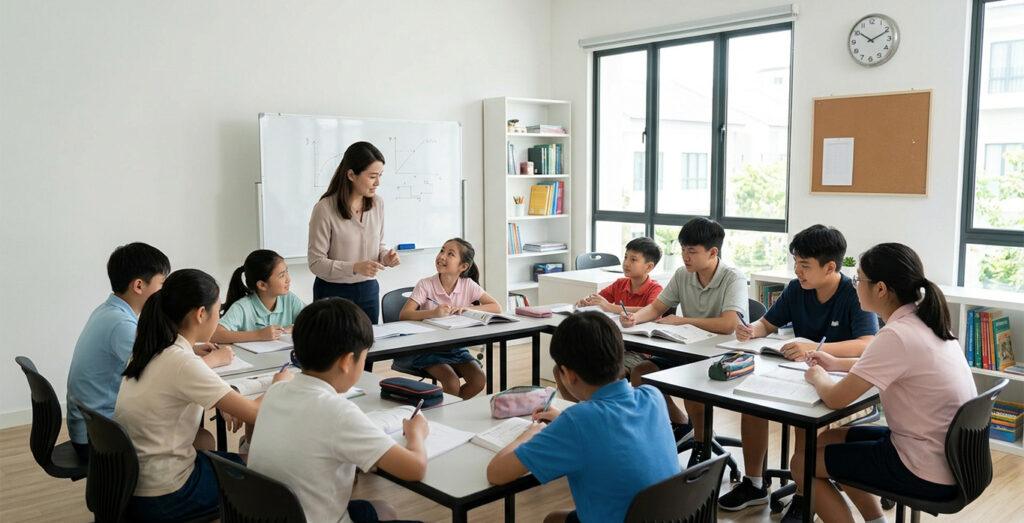
At the other end is a structured learning centre, which operates much like a small school. Students attend on fixed days, sit with a class of peers, are taught by subject specialists, and follow a recognised external curriculum. The child is not at home during school hours. The word “homeschool” applies in the market because these centres are an alternative to mainstream school registration, not because learning happens in a home environment.
The distinction matters because the concerns parents have about socialisation and structure apply specifically to the fully independent model, not to a structured learning centre with a daily timetable and a peer group.
Campus Rangers Learning Centre is a Cambridge IGCSE learning centre in KL that sits at the structured end of this spectrum. It runs a Cambridge Primary programme for Years 1 to 6 and a Cambridge IGCSE programme for Years 10 and 11, with subject-specialist teachers and a fixed academic calendar. Students come in, attend class, join co-curricular activities, and leave. The mechanism is a school. The label, for many parents, is still home school in KL.
Yes, and it is worth being specific about what structure means in practice at CRLC. Students follow the Cambridge Primary curriculum for primary years, with a Primary Checkpoint assessment at Year 6 covering English, Mathematics, and Science. This provides an internationally benchmarked measure of where each student stands, not just an internal grade. At secondary level, Years 10 and 11 follow the Cambridge IGCSE syllabus, with students sitting external examinations set and marked by Cambridge Assessment International Education. The qualification is recognised by the Malaysian Ministry of Education as equivalent to SPM, and by universities in the UK, Australia, the US, and Malaysia.
Timetables are fixed. Subject teachers are assigned. Lessons progress according to a planned syllabus calendar. End-of-year results are externally verified. None of these elements are optional or self-paced in the way that pure home learning can be. A student who attends CRLC has a structured school week, a qualified teacher in every subject, and a year-end examination that reflects actual Cambridge standards.
CRLC’s results confirm this. Across five IGCSE batches since 2012, 100 percent of graduates earned sufficient credits to proceed to tertiary education, and at least 30 percent received college scholarships.
In the 2022 cohort, 75 percent of grades were A* or A, and 94 percent were at credit level or above. These are the outcomes of a structured programme with experienced teachers, not of unsupervised home learning.
The socialisation concern with home school in Malaysia is real when applied to the fully independent model. A child who learns at home without consistent peer interaction misses out on working in groups, managing friendships, and building the confidence that comes from presenting ideas to a room. These are not incidental. They shape a child’s ability to function in tertiary education and in a workplace.
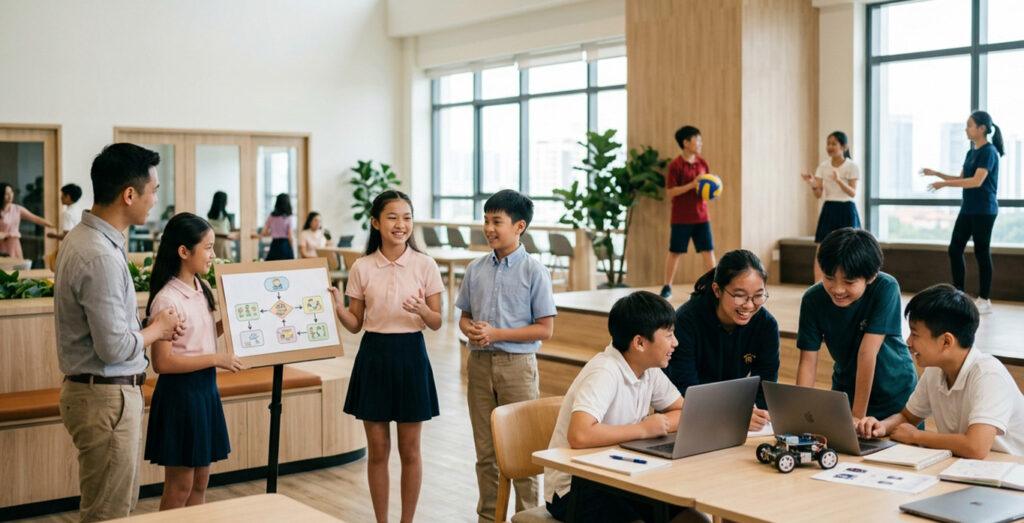
At a structured learning centre like CRLC, this concern looks quite different. Students share a classroom with peers who are also outside the mainstream school system. They work through group tasks, interact with subject teachers daily, and develop the social literacy that comes from a consistent peer environment. That contact is not replicated by time at home.
Co-curricular activities at CRLC extend this further. Students can join a Chinese culture and language club, an entrepreneur club, performing arts, sports teams including floorball, basketball, and badminton, and a coding and game development programme. These are structured peer environments where students build skills and relationships outside academic hours, within the same community they study with. This is the social layer that a home-based model on its own cannot replicate.
For many KL families, the choice of an IGCSE home school or learning centre is not primarily about rejecting mainstream schooling. It is about finding an environment that fits a specific child, offers a Cambridge qualification, and does so at a fee level below the premium international school tier.
CRLC’s fees for the 2024-2025 academic year run from RM 13,980 per year for Years 1 to 3, up to RM 18,960 per year for Year 11. This sits well below the RM 45,000 to RM 130,000 range of premium Cambridge IGCSE international schools in KL, while delivering the same external qualification and exam results.
For a family that wants the Cambridge pathway, qualified subject specialists, and a genuine peer environment, but cannot justify premium international school fees, CRLC closes that gap. The label may say home school in KL. The reality is a structured Cambridge programme at an accessible fee point.

Home education in Malaysia exists in a legal grey area. Under Section 135(1) of the Education Act 1996, Malaysian citizen children aged 6 to 12 are required to attend primary school. Parents who wish to homeschool a child of primary-school age must apply for an MOE exemption, approved case by case through the State Education Department. Secondary-age children face fewer legal barriers.
Not at a structured learning centre. At CRLC, students attend on fixed days alongside a peer cohort, participate in group learning, and join co-curricular activities including sports, performing arts, an entrepreneur club, and coding. The social development that happens in a structured learning environment is comparable to what a mainstream school provides, at a smaller and more intimate scale.
Campus Rangers International School (CRIS) is a fully registered mainstream international school at 9 Seputeh. CRLC is the learning centre arm, running the same Cambridge curriculum at a lower fee point and with greater flexibility on subject selection. Both lead to Cambridge IGCSE certification. The main difference is the registration category and fee structure, not the curriculum or the qualification.
In Malaysia, this term typically refers to a Cambridge IGCSE learning centre that operates as an alternative to mainstream school enrolment. Students attend structured classes, are taught by qualified teachers, and sit the same external Cambridge examinations as students at registered international schools. Campus Rangers began as a learning centre of this kind in 2012 and now operates alongside the fully registered Campus Rangers International School.
The best starting point is a visit. CRLC offers an entrance assessment to gauge each student’s current level before enrolment. This helps match the child to the right year group and subject combination. Visiting the campus, meeting the teachers, and seeing the co-curricular environment gives a far clearer picture than a brochure. Reach out via the Campus Rangers contact page or call the IGCSE Centres team directly.
The label covers a wide range of realities. For families who want structure, qualified teachers, a Cambridge qualification, and a genuine peer environment without premium international school fees, a learning centre like CRLC is the answer. Visit the Campus Rangers Learning Centre page or contact the admissions team to find out more.
 Cambridge Curriculum in Malaysia: What Parents Should Look Beyond the Syllabus
 International School Near PJ or KL: How Should Parents Compare Options?
 Secondary IGCSE in KL: What Parents Should Know Before Year 10
 After SJKC: Is an International School in KL the Right Next Step?
 Preschool to Primary in KL: How to Build a Smooth Cambridge Pathway