
 CN
CN

When parents search for a Cambridge curriculum school in KL or Selangor, they often assume that accreditation is the reassuring part. All these schools follow the same Cambridge syllabus, administered by Cambridge Assessment International Education. The content, the assessment criteria, the grading standards: all of it is standardised across every registered school in Malaysia.
What isn’t standardised is how each Cambridge curriculum school implements that framework. Teaching culture, subject-tier advice, pastoral support, and post-Year-11 guidance all vary between schools, even when the brochure looks the same. These are the variables that shape actual outcomes, and most parents discover them only after enrolment.
This article maps five areas where schools diverge within the same curriculum, so parents know what to look for before they commit.

IGCSE assessment rewards critical thinking, structured argumentation, and applied reasoning alongside subject knowledge. A student who can recall facts but cannot construct an argument under timed conditions will underperform relative to their content knowledge.
This means delivery matters. Two students can cover identical Biology content at two schools and arrive at the exam in very different conditions. One school may have spent Years 10 and 11 developing exam technique alongside the syllabus. The other may have moved through the content without structured preparation. The syllabus was the same. The outcome was not.
The Cambridge curriculum is a framework, not a teaching method. What a school builds within that framework (how it teaches, tracks students, and prepares them for the exam) is what produces the final result.
This qualification is recognised by the Malaysian Ministry of Education as equivalent to SPM, and by virtually every UK, Australian, US, and Singaporean university. That recognition is consistent regardless of which school issued the results. But the grades on that certificate are not consistent: they reflect what each school actually delivered.
Most parents know that IGCSE subjects are offered at Core and Extended tiers. Fewer understand that tier advice at the start of Year 10 is among the most consequential decisions of the secondary school journey.
Core papers are graded C to G. Extended papers are graded A* to E. A student entered for Core in Mathematics cannot achieve higher than a C. That ceiling closes the door to A Level Mathematics, which affects access to engineering, actuarial science, economics, and related programmes. The decision appears administrative at Year 10. Its effects reach through to university admissions.
Schools differ in how they handle this. Some enter students for Core to protect pass rates, even when the student has the ability for Extended. A school that understands its students will give tier advice specific to each subject and each student’s profile. When visiting any Cambridge curriculum school, ask how tier decisions are made and whether students can move from Core to Extended if performance improves in Year 10.
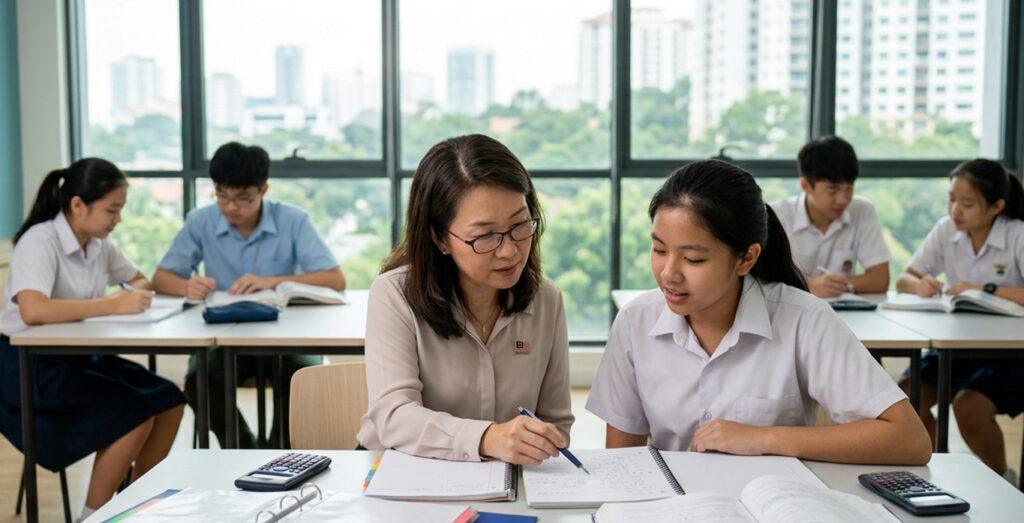
Teacher retention is not a metric schools advertise, but it is one of the clearest signals of institutional stability. A school with high turnover produces fragmented instruction regardless of how strong individual teachers are. Students adapt to new teaching styles at the cost of subject depth.
Class size compounds this. Papers at this level assess extended writing, structured analysis, and applied problem-solving. These skills develop through teacher feedback. In a class of 25, a teacher can mark extended writing once a fortnight. In a class of 12, feedback is more frequent and specific. The difference accumulates across two years of preparation.
Campus Rangers maintains a small-school structure with over 40 qualified teachers averaging 8 to 40 years of experience. Across five IGCSE batches since 2012, teacher continuity and class intimacy have produced a 100 percent tertiary progression rate and at least 30 percent scholarship recipients per cohort.
Cambridge IGCSE examinations run in two annual series: May to June and October to November. Most schools in Malaysia enter students for the May to June sitting at the end of Year 11, but exam entry strategy goes deeper than the series.
Exam entry fees are charged separately from tuition, at RM 200 to RM 500 per subject, paid via the school to Cambridge. A student sitting eight subjects pays RM 2,000 to RM 4,000 in exam fees across the programme, outside annual tuition.
What varies is how strategically entries are managed. Some schools enter all students for all subjects at once in Year 11. Others stagger entries or advise on October to November resits where a specific grade matters for a university application. These decisions are made by the school, not the parent. Any Cambridge school near me worth visiting should explain its entry policy and retake approach before Year 10 begins.
The Extended tier subjects require analytical rigour that many students find genuinely demanding for the first time at Year 10. How a Cambridge curriculum school responds when a student struggles is as important as how well it teaches when things go smoothly.
Schools that measure success only by their top-performing cohort tell you what their strongest students achieved. Schools that report on the full cohort (pass rates, tertiary progression, scholarship outcomes) tell you what the school actually delivers.
Some schools assign a form teacher who oversees academic progress across all subjects and flags concerns to parents early. Others rely on subject teachers to identify issues independently. A student falling behind in multiple subjects may not be noticed until mock results arrive in Year 11, when recovery time is limited.
Ask how the school monitors progress in Years 10 and 11, and what happens when performance drops. This is one of the most useful questions to raise when evaluating any Cambridge school near me on a shortlist.

Year 11 results are not the end. They are the admission document for A Levels, the IB Diploma, a pre-university foundation, or direct tertiary entry in Malaysia or abroad. A school that treats the IGCSE as its final product is only doing half the job.
Not every school following this curriculum offers meaningful pathway support. Some have A Level programmes on-site and walk students through direct progression. Others act as feeder schools for external sixth form centres with limited guidance on which programme fits each student.
Campus Rangers has supported 100 percent of IGCSE graduates into tertiary education across every batch since 2012. The school’s secondary programme feeds directly into the next stage, with teachers and advisors who know each student’s subject profile and give specific rather than generic post-IGCSE guidance.
Yes. The syllabus is standardised by Cambridge Assessment International Education and applied uniformly across all registered schools. What differs is how each school delivers, monitors, and prepares students within that syllabus. Teaching quality, class size, exam entry strategy, and pastoral support all vary independently of the curriculum itself.
Ask directly when you visit. Request the school’s tier guidance policy and ask whether decisions are made per student or applied broadly to the class. Ask whether students can move from Core to Extended entry if performance improves in Year 10.
No. Entry fees are charged separately. Each subject costs RM 200 to RM 500, paid by the school to Cambridge Assessment International Education. A student sitting eight subjects typically pays RM 2,000 to RM 4,000 in examination fees across the two-year programme.
Yes. The Malaysian Ministry of Education recognises it as equivalent to SPM, provided the student has passed at least five subjects at grade C or higher. Malaysian public universities including UM, UKM, UPM, and USM accept IGCSE on this basis, and most private universities accept it directly.
Ask what percentage of graduates progressed to tertiary education and what destinations they went to. Ask whether A Level or pre-university programmes are offered on-site. Ask how advisors guide students through subject selection after Year 11. A school that answers with specific data, not general statements, takes post-IGCSE outcomes seriously.
With 216 Cambridge IGCSE schools registered in Malaysia, the curriculum itself is not the differentiator. What separates schools is the quality of teaching, the honesty of tier advice, and the depth of support when a student finds part of the programme difficult. To see how these five areas are handled in practice, visit Campus Rangers International School and ask the questions that matter.
 International School Near PJ or KL: How Should Parents Compare Options?
 Secondary IGCSE in KL: What Parents Should Know Before Year 10
 After SJKC: Is an International School in KL the Right Next Step?
 Preschool to Primary in KL: How to Build a Smooth Cambridge Pathway
 Affordable International School in KL: What Does “Value” Really Mean?