
 CN
CN

Many KL families face this choice at the end of Standard 6. Six years of SJKC have produced a child who is trilingual, mathematically strong, and accustomed to a demanding academic pace. The next step is a real question. Stay within the national system. Move to a Chinese Independent High School. Or make the switch to an international school in KL.
The last option is becoming more common. Parents wanting a globally recognised qualification and an international university pathway are increasingly looking at Cambridge IGCSE. What they’re less clear about is how well SJKC prepares a child for that environment. And where the gaps will show up.
This blog answers that directly. It maps what SJKC builds that transfers well into a Cambridge curriculum school and what it doesn’t. It also covers what parents should look for when evaluating secondary schools for their Standard 6 child. Those questions typically matter far more than any school’s name or published fees.
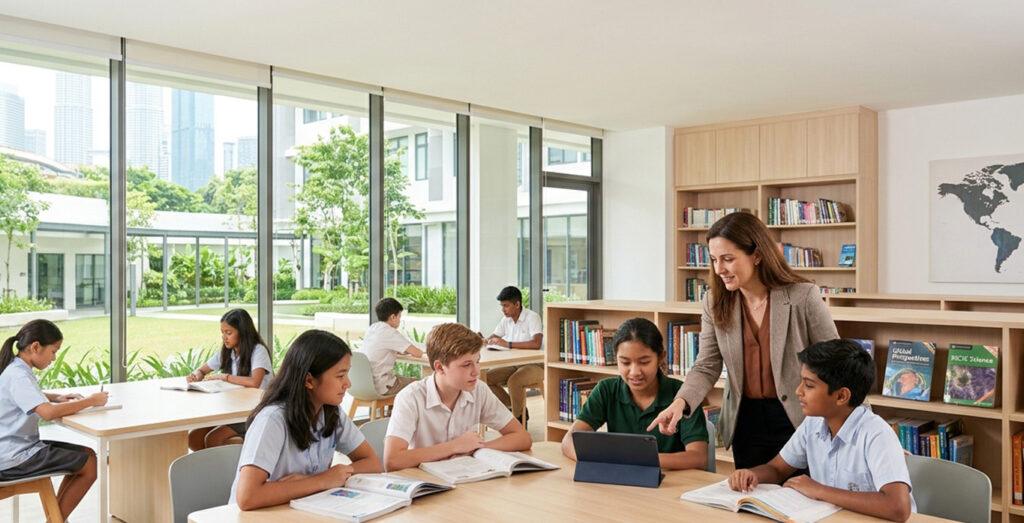
An international school in KL is a private educational institution. It follows a foreign curriculum with English as the primary language of instruction. The most common Cambridge pathway runs from Cambridge Primary through to IGCSE in Years 10 and 11. Students graduate with an internationally recognised secondary qualification. The Malaysian government’s official primary school education page confirms that international schools use approved foreign curricula. This includes the British Cambridge curriculum, rather than the KSSR national syllabus that governs SJKC.
The contrast matters in practice. SJKC runs on Mandarin-medium instruction using KSSR standards. A Cambridge curriculum school runs on English-medium instruction using Cambridge frameworks. The transition between them is not just a language switch. It’s a shift in how learning is structured and how students are expected to engage with content. Assessment changes too. Understanding that distinction before Year 7 allows families to plan the transition rather than react to it. The medium of instruction, assessment style, and learning philosophy differ substantially from what most SJKC students have experienced.
Parents often underestimate what six years of SJKC actually produce. Before focusing on the gaps, it’s worth being accurate about the strengths.
Strong mathematical foundations. SJKC runs a famously fast-paced Mathematics curriculum. Students who complete Standard 6 typically have number fluency, calculation speed, and problem-solving habits that are above the average for their age group. Cambridge Primary and IGCSE Mathematics reward all of these. The content framing is different, but the underlying numeracy is not. An SJKC student entering Year 7 of a Cambridge curriculum school often finds Mathematics the least stressful part of the adjustment.
Trilingual capacity. SJKC graduates are functional in Mandarin, Bahasa Malaysia, and English by Standard 6. The Mandarin and BM levels are stronger than most comparable age groups; the English is functional but not yet academic. That linguistic range is a real asset. Cambridge schools serve multicultural populations, and students who are already comfortable switching between languages adapt faster to English-medium instruction than monolingual children.
Work ethic and academic discipline. SJKC is demanding. The pace is fast, homework is substantial, and academic seriousness is the norm. Children who come through six years of SJKC are used to working hard. That discipline is not wasted in Cambridge secondary. It doesn’t solve the language adjustment, but it means the child will apply effort when effort is required. That consistency matters more than people credit.
These habits also show up in examination preparation. An SJKC graduate enters exam revision with fewer behavioural adjustments than a child who hasn’t been pushed academically. The content is different. The mindset is already there.
“An SJKC graduate entering Year 7 is not starting from zero. They bring mathematical fluency, trilingual range, and academic discipline that many peers in a Cambridge environment haven’t yet developed.”
Understanding the gap is the more important part of the preparation. Most SJKC parents underestimate it. Not because they’re inattentive, but because SJKC is genuinely rigorous and it’s hard to imagine Cambridge being meaningfully different. It is.
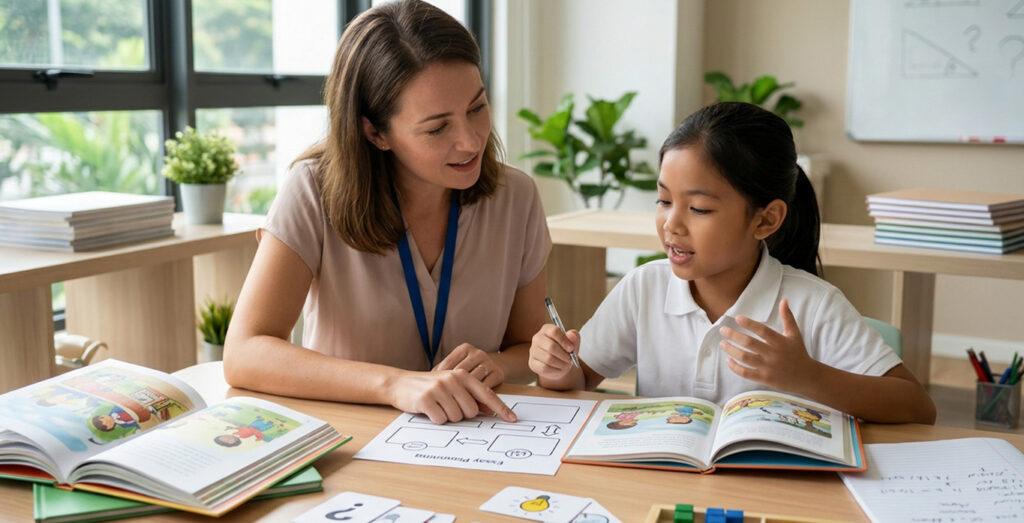
English as an academic medium. SJKC teaches English as a subject, not as the language everything else is taught in. A child who scores well in English at SJKC has good vocabulary and reasonable grammar. That’s not the same as a child who can follow a Science lesson in English, write an extended History response in English, or read and annotate a literary text in English. The switch from English-as-subject to English-as-medium is significant. Most SJKC entrants to Cambridge schools need structured English support in Year 7 and Year 8.
Inquiry-based and analytical thinking. KSSR, the curriculum SJKC follows, is content-driven. Students learn defined material and are assessed on how well they recall and apply it. Cambridge works differently. From Year 7 onward, students are expected to construct arguments, evaluate evidence, and reach their own conclusions. Science papers ask students to design experiments and critique methodology. History papers ask for source analysis and an essay-based argument. English literature asks for personal interpretation of texts. None of this is rote. An SJKC student who is very good at KSSR-style learning may find the Cambridge assessment style unfamiliar at first.
Extended writing in English. Related to both points above, but worth naming separately. Cambridge IGCSE papers across almost every subject require extended written responses in English. A student who can write short correct sentences in English but hasn’t practised constructing sustained analytical paragraphs will find this demanding. The skill isn’t impossible to develop, but it takes time and it takes structured teaching. It’s one of the most important things to ask a Cambridge curriculum school about: how do they specifically support Year 7 students who are still developing academic English?
“The Cambridge switch isn’t just about the language. It’s about how thinking is expected to happen. SJKC trains students to master content; Cambridge trains them to argue with it.”
Not every Cambridge curriculum school is equally equipped to handle the SJKC-to-Cambridge transition. Some schools assume students arrive already fluent in academic English and build no specific bridge for those who don’t. Others have developed structured Year 7 programmes that explicitly address this transition. The difference in Year 9 and Year 10 results between these two approaches is significant.
English language support. Ask directly whether the school has an English as an Additional Language (EAL) or English bridging programme for Year 7 entrants. Ask what it looks like, how long it runs, and how progress is tracked. A school that gives a vague answer probably doesn’t have a proper system. A school that can name the specific approach, the teacher responsible, and the expected timeline for transition has thought about this seriously.
Class sizes in Year 7 and Year 8. The English language gap is closed through teaching interactions, not independent study. A class of 30 students doesn’t give a teacher enough time to give meaningful individual feedback on written work. A class of 15 to 20 does. For an SJKC student making the curriculum switch, class size in the first two years of secondary is more important than almost any other factor.
Teacher experience with curriculum transitions. Ask whether teachers have experience supporting students who have come from Chinese-medium or national-type primary schools. It’s a specific skill. A teacher who has only ever taught students arriving from English-medium primaries may not recognise where an SJKC student is getting stuck or how to help them bridge the gap efficiently.
Results and outcomes. Ask specifically about IGCSE outcomes for students who joined at Year 7 from SJKC or other non-English-medium primaries. If the school has that data, they’ve been tracking this transition carefully. If they don’t, that’s worth noting.
Campus Rangers has produced five batches of IGCSE graduates. 100% achieved enough credits for tertiary education and at least 30% received scholarships from colleges. That outcome record is a clearer signal than an open day presentation.
For families wanting a Cambridge qualification and English-medium university options, an international school in KL is a strong post-SJKC pathway. The SJKC years aren’t wasted. The Mathematics, the work ethic, and the trilingual range all carry forward. What needs to be built is English as an academic medium and the argumentative, inquiry-based thinking style that Cambridge rewards. A KL primary school to Cambridge secondary transition is entirely doable. Many students who make it with the right support produce IGCSE results that match or exceed those of peers from English-medium primaries.
Yes. Most international schools in KL that offer secondary education accept students at Year 7 regardless of their primary school background. An entrance assessment is standard practice. It determines placement and identifies where language or subject support may be needed. The assessment isn’t a barrier; it’s a diagnostic tool. Schools use it to understand where a student is, not to reject those who haven’t had English-medium primary education.
English will likely be the most demanding adjustment in Year 7. SJKC teaches English as a compulsory subject under KSSR. But Cambridge requires English as the medium for all subjects, extended writing, and examination responses. That’s a higher bar than SJKC prepares for directly. Most schools with experience in this transition have structured English support in Year 7. The adjustment typically takes one to two years before the child is fully comfortable with academic English across all subjects.
Both are common post-SJKC pathways. A Chinese Independent High School continues Mandarin as the medium of instruction. It leads to the UEC, which some Malaysian and overseas universities accept. An international school in Malaysia follows an English-medium Cambridge curriculum leading to IGCSE. IGCSE is accepted by universities in over 160 countries. The choice depends on whether the family’s priority is Mandarin continuity or English-medium international university access.
Most students find that the language and learning style adjustment takes between one and two years. Mathematical and logical subjects often feel easier from the start. English-medium subjects, particularly those requiring extended analytical writing, take longer. Students with smaller class sizes and structured EAL support tend to adjust faster. By Year 9, most SJKC-background students with strong early support are performing on par with peers from English-medium primaries.
An SJKC is a national-type Chinese primary school following the KSSR curriculum in Mandarin. A KL primary school using Cambridge Primary builds English-medium analytical and inquiry skills from Year 1. The academic pace in SJKC is often faster, and the Mandarin and Mathematics foundations are typically stronger. However, the teaching methodology, language of instruction, and assessment philosophy are fundamentally different from Cambridge. Students who enter a Cambridge curriculum school from SJKC are academically capable. They need support adjusting to how Cambridge expects them to think and write, not only what to know.
The SJKC years are not a disadvantage going into Cambridge secondary. The Mathematics, the trilingual range, and the discipline built across six years are real assets that carry forward. What the transition needs is a school that builds on those assets while closing the specific gaps SJKC doesn’t cover. Small classes, structured English support, and experienced teachers will most determine whether the move works well. Campus Rangers International School is a Cambridge curriculum school in KL with 40 qualified teachers. Five batches of IGCSE graduates have come through the programme, all of them. To understand how the secondary programme is structured, the Campus Rangers Learning Centre page covers the Year 7 to Year 11 pathway in detail. For parents comparing the IGCSE route with the SPM pathway, the IGCSE versus SPM guide covers the qualification differences directly. The admissions page explains the entrance process and what to expect when your child sits the assessment.
 Cambridge Curriculum in Malaysia: What Parents Should Look Beyond the Syllabus
 International School Near PJ or KL: How Should Parents Compare Options?
 Secondary IGCSE in KL: What Parents Should Know Before Year 10
 Preschool to Primary in KL: How to Build a Smooth Cambridge Pathway
 Affordable International School in KL: What Does “Value” Really Mean?