
 CN
CN

Most families in KL make two separate school decisions. First, they find a preschool. Two or three years later, they look for a primary school. The two choices rarely get made in the same conversation. That’s the gap where things can go wrong.
A child moving from play-based, inquiry-led learning into a fully structured classroom can take much of Year 1 just adjusting. That adjustment doesn’t show up on any enrolment form. It affects how quickly a child settles, how confident they feel, and how much of the early curriculum sticks.
Families who choose a preschool in Kuala Lumpur with Cambridge primary continuity in mind skip that reset entirely. This blog explains why the transition matters and what it looks like when it goes well. It also covers what parents should ask before enrolling in either stage.
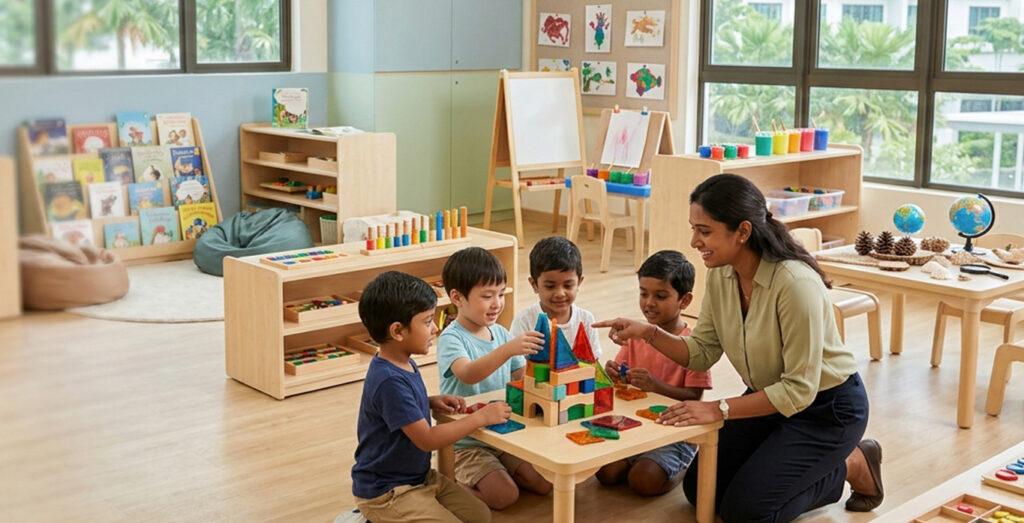
A preschool in Kuala Lumpur is an early childhood education programme for children typically aged 4 to 6. It covers the years before formal primary school begins. In the international school corridor, most preschools follow the Early Years Foundation Stage (EYFS) framework. This was developed by the UK Department for Education. EYFS covers seven areas of learning. EYFS covers seven learning areas. These span Communication and Language, Physical Development, Literacy, Maths, Understanding the World, Personal and Emotional Development, and Expressive Arts. At a good international preschool in KL, these areas are taught through structured play and guided exploration, not formal instruction. The goal is school readiness, not early academics.
The shift from preschool to Year 1 is the first major educational transition a child makes. It’s also the one parents tend to underestimate.
Preschool is designed around the child’s pace. Activities are shorter, more varied, and guided by the child’s interest as much as the teacher’s plan. Learning happens through doing: building, sorting, drawing, role play, and conversation. Children are not expected to sit for extended periods or produce written work. The environment is nurturing and responsive.
Cambridge Primary Year 1 is structured differently. The Cambridge Primary programme typically covers children aged 5 to 11, across six stages. From Stage 1, students begin working toward defined learning objectives in English, Mathematics, and Science. Tasks become more focused. Written output increases. Expectations around independent working and sustained attention grow quickly through Stage 1 and Stage 2.
The gap between these two environments is real. A child entering Year 1 without those foundational habits will take time to find their footing. The ability to follow multi-step instructions, persist through tasks, and communicate in writing is assumed from early in Stage 1. A child who hasn’t built those habits yet spends the first term catching up instead of learning.
“The first term of Year 1 tells you more about a child’s preschool than any admissions form does. Children who arrive with strong listening habits and self-regulation skills settle faster and engage sooner.”
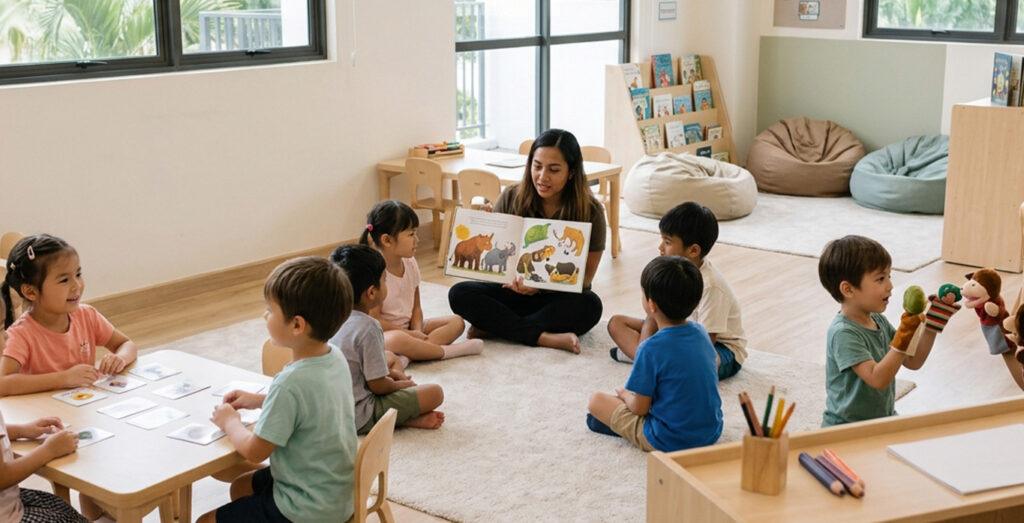
Understanding the EYFS-to-Cambridge connection helps parents choose a kindergarten in Kuala Lumpur that actively prepares for what comes next. It helps them choose one that actively prepares for what comes next.
The EYFS Communication and Language strand develops listening, attention, and the ability to articulate ideas. These are the direct precursors to Cambridge Primary English. Reading comprehension, verbal reasoning, and extended writing all depend on a child who can sustain focus on language. A child with two years of structured conversation and oral expression arrives in Year 1 with a stronger English foundation. That advantage shows from the first week.
The Personal, Social and Emotional Development strand is less visible but equally important. It builds the habits of group work, self-regulation, and resilience that underpin Cambridge Primary learning. Children who manage frustration, take turns, and persist through difficulty do better as the curriculum grows in demand. These aren’t soft skills alongside the academics. They’re the operating system the academics run on. A child without self-regulation by Year 1 will spend more time managing their own reactions than engaging with content.
The EYFS Mathematics strand introduces number sense, pattern recognition, and early problem-solving through hands-on activities. Cambridge Primary Mathematics in Stage 1 and Stage 2 builds directly on these foundations. Children who arrive with concrete mathematical thinking find the abstract progressions easier to follow. Those who don’t often spend Stage 1 playing catch-up on concepts that should have been established earlier.
The IGCSE primary school curriculum overview explains how each Cambridge Primary stage builds on the previous one.
The curriculum mismatch problem is most visible at the transition point, but it starts earlier than that. The teaching philosophy a child absorbs in preschool shapes their assumptions about what learning looks like. A child who expects exploration may struggle in a classroom that expects compliance. The reverse also holds.
A kindergarten in Kuala Lumpur that runs activity-only learning without skill progression may produce children who are sociable and happy. But they may not have built the literacy and numeracy habits Cambridge Primary expects. The reverse problem also exists. A preschool that pushes academics too early can produce technically ahead children who lack the curiosity the Cambridge approach rewards.
Neither mismatch is obvious at the point of preschool enrolment. Both show up clearly in Year 1.
The smoothest transitions happen when the teaching philosophy is coherent across stages. This is why some families seek an international preschool in KL within the same school as their planned Cambridge primary. A school that runs its own EYFS preschool and feeds directly into Cambridge Primary understands both ends of the transition. Teachers know what Year 1 expects. The preschool curriculum is calibrated to build toward it. The child’s record travels with them. Classroom culture stays consistent: how teachers speak, how learning is structured, and what values are reinforced day to day.
“The question isn’t just ‘is this a good preschool?’ It’s ‘is this preschool building toward what the Cambridge primary school next door will ask of my child?'”
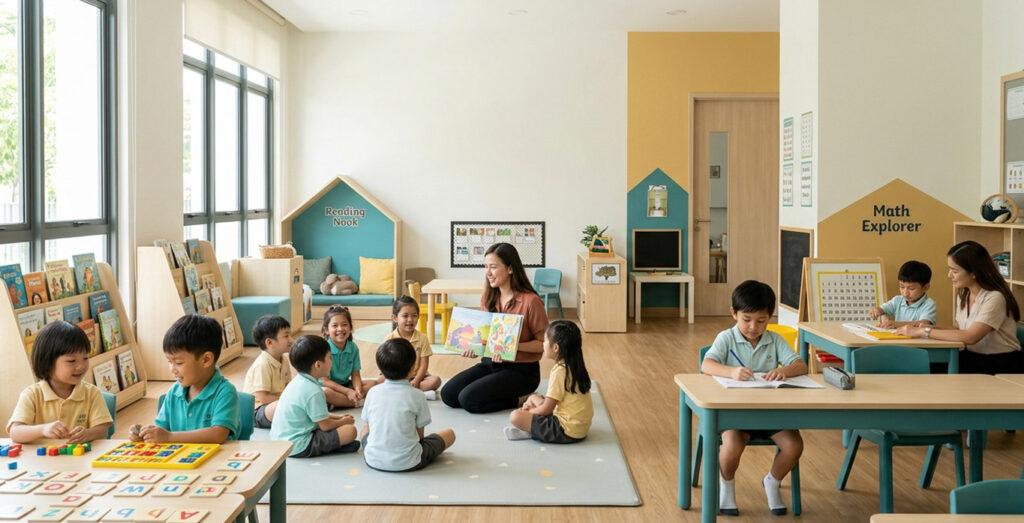
For parents planning an IGCSE primary school pathway, choosing a preschool in Kuala Lumpur requires slightly different questions.
Ask whether the school runs both stages. A school that offers EYFS preschool and Cambridge Primary in the same building removes the transition problem almost entirely. The child doesn’t change environment, teacher culture, or peer group at Year 1. What changes is only the curriculum stage. That’s a much smaller adjustment than a full school move.
Ask about the preschool’s teaching approach in the run-up to Year 1. A good EYFS preschool doesn’t just play and then stop. In the K2 year, it introduces children to structured group activities, phonics, early number work, and more sustained task completion. This isn’t about pushing academics early. It’s about calibrating the preschool’s final year to the primary’s first year, so the child arrives prepared rather than surprised.
Ask what Year 1 expects in the first term. If the primary school can tell you clearly what children are expected to be able to do on Day 1 of Year 1, that tells you what the preschool needs to have built. A primary school that can articulate this clearly thinks about transitions deliberately. If they can’t answer this question, that’s worth noting.
Ask about staff continuity between the preschool and primary. Teachers who have worked across both stages understand the developmental arc better than those who have only ever taught one level. Schools with cross-stage teacher experience tend to have more coherent handover processes. At Campus Rangers, teachers with 8 to 40 years of experience work across the school ecosystem, and the Rangers Kidz preschool sits on the same campus as the International School. The handover from EYFS to Cambridge Primary is a structured internal process, not an assumption.
For Cambridge-pathway families, moving from a well-run EYFS preschool into an IGCSE primary school is the natural progression. Cambridge Primary builds the academic skills and inquiry habits that feed into Cambridge Lower Secondary and then IGCSE. The earlier that continuity starts, the more compounded the benefit is. A child with eight or nine years inside the Cambridge framework arrives at Year 10 better prepared for IGCSE demands. Switching systems in Year 3 or Year 5 disrupts that continuity. It doesn’t make IGCSE impossible, but it adds friction to the pathway that the pathway doesn’t need. The pathway works best when it starts early and stays consistent.

Most EYFS-based preschools in KL accept children from age 4, typically entering K1. Some schools take children from age 3 in nursery or pre-K programmes. Starting at 4 gives children two full years of EYFS before Year 1 of Cambridge Primary at age 6. Two full years give enough time to build the communication, social, and literacy habits that primary school relies on.
You don’t have to, but thinking about them together helps. For an IGCSE primary school pathway, look for a preschool that feeds in directly or uses EYFS aligned with Cambridge. Both make the transition intentional. Choosing a preschool without thinking about primary school continuity can mean a harder Year 1 transition.
In Malaysia, the terms are often used interchangeably. Most early childhood centres in KL for children aged 4 to 6 call themselves either kindergarten or preschool. The difference that matters is the curriculum and teaching philosophy, not the label. A kindergarten in Kuala Lumpur running EYFS is functionally the same as a preschool running EYFS. Ask about the curriculum framework, not just the name.
An international preschool in KL follows a foreign curriculum framework, most commonly EYFS from the UK. English is the primary language of instruction. Local kindergartens typically follow the Malaysian National Preschool Curriculum and may use Bahasa Malaysia or Mandarin as the main language. For Cambridge-pathway families, an international preschool in KL using EYFS provides a more directly aligned early foundation.
EYFS and Cambridge Primary are not formally part of the same programme, but they are designed with compatible learning philosophies. Both prioritise active learning, inquiry, and skill development over rote memorisation. EYFS builds the foundational literacy, numeracy, and self-regulation skills that Cambridge Primary Stage 1 builds upon from Year 1. Schools that run both programmes ensure the transition between them is intentional, not accidental.
The choice of a preschool is rarely thought of as the first step in a long academic journey. In practice, it is. The habits, skills, and learning dispositions a child builds in those early years travel with them into primary school. They shape how quickly children settle, how confidently they engage, and how well they absorb a more structured curriculum. Families who start the Cambridge pathway at preschool level tend to find each stage easier to navigate.
When both stages are under one roof, the benefits compound further. The child knows the teachers, the culture, and the expectations. The Year 1 classroom isn’t a new environment: it’s the next room. That continuity is something no amount of preparation can fully replicate for a child moving between two different schools. It removes the social and environmental adjustment from the equation, leaving only the academic one. A child already familiar with the school’s teaching approach finds even the academic adjustment smaller than expected. To understand how Rangers Kidz prepares children for the Cambridge years ahead, the Rangers Kidz preschool page explains the EYFS approach in detail. The IGCSE primary school curriculum guide covers how Cambridge Primary develops across each stage. Both pages are worth reading together. The preschool and primary decisions aren’t separate: they’re parts of the same one. The admissions page outlines the process for both Rangers Kidz and Campus Rangers International School when you’re ready to start.
 Cambridge Curriculum in Malaysia: What Parents Should Look Beyond the Syllabus
 International School Near PJ or KL: How Should Parents Compare Options?
 Secondary IGCSE in KL: What Parents Should Know Before Year 10
 After SJKC: Is an International School in KL the Right Next Step?
 Affordable International School in KL: What Does “Value” Really Mean?